Google Search

Google
 
Showing posts with label Austria. Show all posts

Friday, October 28, 2011

Dr. Eduard Hapsburg Speaks on Church Crisis in Austria

On the afternoon of October 27th, Dr. Eduard Hapsburg spoke with Franciscan University students about the crisis of faith in the church of Austria.

With his perfect English, engaging personality, and personal experience working for the Austrian Catholic church, he electrified the room of students with some astonishing facts:

- that many confirmation candidates in Austria are unable to recite the Our Father
- in this historic bastion of Catholicism, adoration and confession are in many places taboo
- that priests are lonely, hopeless, overburdened, overworked, and under-appreciated
- that the contemporary situation in Austria is similar to the 7th century when the first Benedictines came to Christianize the land.  Austria is back to ground zero and is in need of missionaries again.
- that an overwhelming majority of Catholics are unable to explain the basic tenets of their faith, even those which work for the church.
- that there is an extraordinary church bureaucracy of over 60,000 employees, many which are without faith and working only to enjoy the salary and social benefits of a comfortable job.

He spoke of the need to pray, do penance, and encouraged lay missionaries to give their witness and talent to the German speaking lands.  He also spoke of Church wealth, the Church-Tax, and monolithic church bureaucracy which has become too comfortable and complacent.

But, even so, the current church structure is crumbling, he asserted.  Furthermore, he spoke of a new church organization which was beginning and would evolve over the coming years.

In the end, while the situation is dire, there is still hope, he professed.  Going back to the Reformation, he reminded the students that practically the whole land converted to Protestantism, before returning back to its Catholic roots. It has been worse.  In the past, it was easy to "go with the flow" of religion.  But, in today's climate, it is different.  Going with the flow means getting swept away in secular culture, not in the current of the church.  As such, tepid and lukewarm Christians will slowly trickle out of the church.  Nevertheless, pruned, it will grow again, it will grow anew.

As a final call to action, Hapsburg challenged all students, "If you don't speak of Christ, who will? Each one of you must be missionaries and speak about your Christian faith."  

Wednesday, September 28, 2011

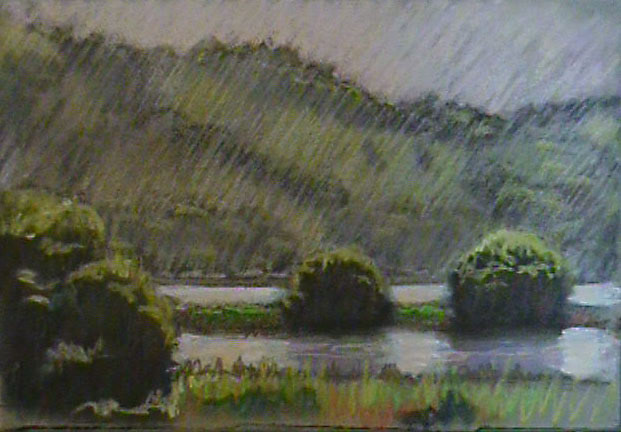
Austrian Rain

A poem by Leanna Praetzel, Fall 2011


Austrian rain

Came.
Simply not
The same.
Swift the song
All along
Red roof,
Window pane.

Your name,
Scattered

In the breeze.
Carried clouds
About,
Among the trees,
Mountain top,
Through my hair.

You were there.

Thunder,
Soft and sweet.
Different.
Sin
And mercy meet.
At my window,
In my room,
Incomplete.

Friday, January 7, 2011

On Pilgrimage to Austria

Perhaps the symbol that best represents our experience of Austria is the magnificent cathedral or towing church spire that jets up into the blue aurora of heaven. Coming from modern America, these vestiges of civilization are not only places of divine worship, but also centers of culture and learning.

With the close of the Platonic Academy in Greece, the fall of Rome, the chaos around the continent, and the dawn of St. Benedict and his balanced vision of work and prayer, Ora et Labora, the monastery became a privileged place in European societyy and for Western Civilization in general. The monasteries preserved the ancient manuscripts, fostered intellectual growth and development, and nurtured Christianity in an otherwise dark age.


Certainly the apogee of the monastic life culminated in the Middle Ages. In the late 1700’s, it took an extreme decline after the Hapsburg Emperor Joseph II closed many contemplative monastic orders in Austria. Nevertheless, there are a host of beautiful and extremely active monasteries crisscrossing the country. For the average American whose history is no more than a few hundred years old, the monasteries are stunningly incredulous, spanning over a millennium with all their architectural grandeur and sublime atmosphere. For example, the glorious cathedral in Melk stands in all its grandiloquence off the main interstate that connects Vienna and Salzburg and dates back to 1089 when Leopold II gave the castle to Benedictine monks from Lambach. Today, they run an active school for over 300 boys and girls, and offer tours to literally thousands of visitors. Its modern museum, stunning library and magnificent Baroque church offer a pictorial history of former times as well as its work and prayer in the modern world.

Another fabulous monastery in Austria is Klosterneuburg, on the outskirts of Vienna. For nearly 900 years the Augustinian canons of the Monastery have performed pastoral, economic, social and cultural functions. Their wine production is especially exquisite as their vineyards are distributed across four famous wine towns and villages: Klosterneuburg, Vienna, Gumpoldskirchen and Tattendorf, boasting prize-winning wines in nearly all categories. In addition, numerous artistic treasures and the impressive architectural heritage can be viewed via the thematic tours through the monastery or by visiting the monastery museum. Even more impressive, the area is bedewed in faith as it serves the modern world through its dedication to faith and culture.


Another specifically European tradition associated with these monasteries is the idea of a pilgrimage. In America we walk literally everywhere, even just down the road. But in Austria as with other places in Europe, the age old custom of going on a pilgrimage is still alive. Pilgrims travel sometimes hundreds of miles on foot to visit a locale of faith, seeking union with God or a special favor.

Just one hour from our Austrian Campus in Gaming, there is small town of a few thousand people named Mariazell. Yet, despite its remote location, it hosts over 1 million pilgrims a year who come on foot, bus, and van to visit the Basilica dedicated to the Blessed Virgin Mary. Many miracles including healings have happened here, and consequently many of the sick person’s belongings such as crutches have been left in thanksgiving—quite the site to see. These tokens of affection including many gifts and cards are preserved above the church in the museum. Ironically, pulling off the side of the road last week, we stopped for a few minutes at the monastery of Heiligenkreuz. As we toured the grounds, I noticed a sign for a pilgrimage path to Mariazell, over 100 kilometers away! It was evident that many make the pilgrimage starting at austere but charming Cistercian abbey and ending at the other end in a gorgeous rococo cathedral.

Indeed, on the outside and from afar, a grand basilica or cathedral often looks dark and dreary.One can hastily inquire: why stop and go in? But once inside, with the sun shining through the stain glass windows, its transcendent beauty pervades and triumphs over former prejudices.

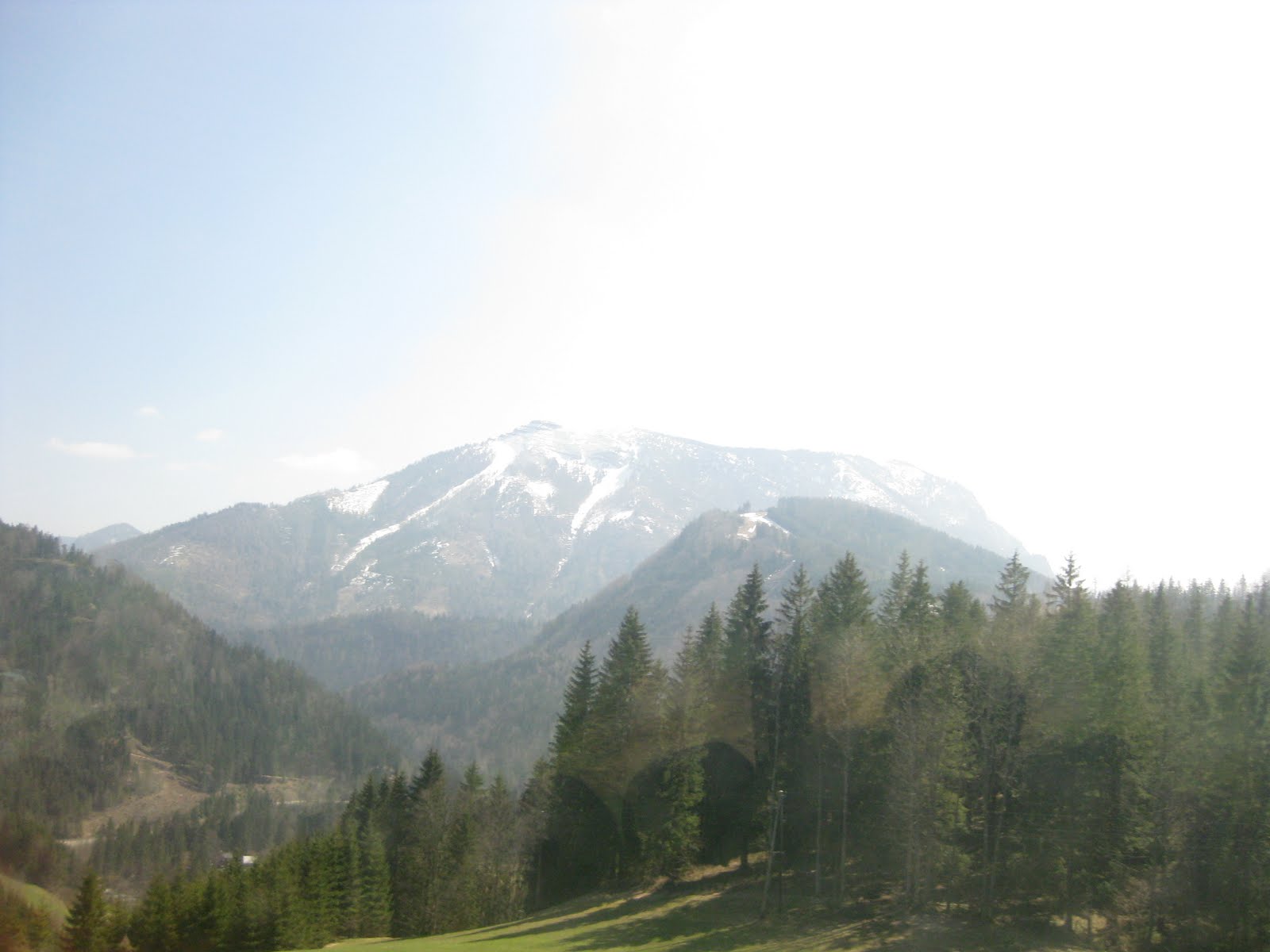
Our experience of Austria has been apt. We didn’t know what to expect from a small tiny country which was a center of Nazism and used to be the center of the Holy Roman Empire. Yet, after living here five years, its magnificent landscapes, the friendliness of its people, the purity of its water, mountains, and air, its preeminence in music, skiing, and culture, and its often idiosyncratic but understanding way of looking at the world has captivated our hearts and won us over. Austria shines with all the glory of a stained-glass basilica or cathedral.

The question is: are you willing to make the pilgrimage, to make the sacrifices and come and see for yourself. In former times, they had it right: they knew that good things often take a journey with much sacrifice on the way.

This has been our experience. We left home on pilgrimage to Austria. We gave up our car, house, and many of the comforts of American life. I’m still an American patriot at heart, with all my passion for red, white, and blue. But in leaving America we discovered Austria in all its beauty.Come see it from the inside! Come and brave small town Austria.


Monday, May 3, 2010

A Truly Austrian Experience


A blog post by Trish Irvine, Spring 2010

Austrian Farm

Sometimes in our quest to “experience Europe” we neglect to experience Austria. Of course, we spend much of our time here due to studies, but it seems to be an oasis of Americanain the midst of Austria. We race to Vienna and Salzburg to explore the depth of history there when it is truly surrounding us every moment at the Kartause. It doesn’t make sense to only see the big cities of a country—I would be insulted if someone said they had experienced the USwhen they only visited New York City. In the past week I have been able to experience three different events that have helped me see the beauty of Austria in a setting much closer to home.

A family that I do Ministry to Moms for took me to the farm of a couple they know. I had mentioned in my application that I live on a farm and enjoyed it, so the family promised to take me to their friends’ farm sometime. I walked into their house one evening and it was announced that today was the day we were going to the farm. A couple of the kids were sick so only part of the family went.

When we arrived at the farm it was to see a tall man wave at us and greet us warmly. His name was Tony and he asked if I spoke German. I was sad to inform him that I didn’t. Soon, his wife Krista came out and introduced herself. She speaks English quite well whereas Tony speaks a little bit. There were times when it didn’t matter that Tony and I couldn’t verbally communicate—he smiled so much that I felt he must be such a beautiful man when we had barely spoken. They kindly invited us to see their farm and then asked us in for drinks. Setting a tray of dessert on the table, they encouraged us to partake. When the tea was ready, they served it to us and then Tony offered some schnapps to us.

The kitchen was warm and bright. It wasn’t like I had imagined because I hadn’t thought to imagine anything, but it seemed to be everything an Austrian home should be. Good conversation that was a mingling of three different languages (Slovak, German, and English) with a warm atmosphere was more than delightful. In the end, I left the farm with a large smile on my face; I had encountered the ‘real’ Austria and not the part that is shown to the tourists. The kindness of the people was genuine and heartfelt. It was hard to imagine that for months I had lived so close to such people while never encountering them.

Mariazell

On Saturday the school gave us the option to hike to Mariazell, the most visited Marian shrine in central Europe. The hiking route takes six to eight hours to complete on average and winds along beautiful Austrian scenery. I got different figures depending on the time and the person, but the hike was around 13-16 miles, although I am apt to say the longer figure is correct because it sounds better. The scenery we walked through was beautiful—mountains with trees surrounding a winding river that roared at points and babbled at others. Besides the splendor of the hike was getting to know people I was walking with. It was also interesting to pray the rosary in as many languages as we knew as we walked. The beauty of the weather was also perfect—cool enough to not be overheated but warm enough to wear short-sleeves.

There were definitely portions of the hike that were more difficult than others but in the end the challenge of the hike was the distance. I was proud to complete the entire hike without taking a shuttle for the latter portion. When we finally reached Mariazell, our feet were sore but we felt accomplished. After we had been there for a while the bus arrived with the non-hikers. I couldn’t help but envy them as they looked all bright and fresh after a mere hour bus ride. Yet I definitely wouldn’t trade the experience I had of hiking and conversing with my classmates.

When someone at home asks me how Austria was, I would like to be able to say more than “Good” before launching into how the other countries were. Austria is more than just the home of Gaming or our starting/ending point for European travels. Austria, for four beautiful months, was our home. The hike to Mariazell allowed me to see more of the country I have lived in and experience the devotion of the people.


Gaming United

On Sunday, April 18th, the Gaming community joined with the Kartause community to help raise money for Haiti. Although it was definitely a wonderful event for the people of Haiti who will benefit from the donations, it was also good for the students as well. It was nice to walk around and hear the meshing of languages. The dancing portion of the event, where different people were able to showcase different dances, was interesting. The Austrian slap dancers set everyone into fits of laughter and the LCI (Language and Catechetical Institute) students from China relaxed us with a demonstration of Tai Chi. It was wonderful to see the different groups that helped pitched in from both communities to make the event possible. A close tie was watching Fr. Ron walk around, admiring everything and commenting on the role everyone played in the event.

All of these events increased my appreciation for the country of Austria and more specifically the area surrounding Gaming. The town of Gaming isn’t a place that would attract much attention; there are many other places in Austria filled with beauty and history. Yet Gaming has been my home for nearly four months and has a special place in my heart. The combination of these events helped me see more of Gaming, experience the ‘real’ Austria, and feast my eyes on beauty everywhere. Gradually my thankfulness is growing to encompass more fully the ‘down time’ spent here in Austria; the time spent not traveling to other countries but staying close by. With a semester full of wonderful memories, some of the most unforgettable experiences were here in Gaming.

Monday, April 27, 2009

Frisbee Champions


For those that know Franciscan University of Steubenville, Ultimate Frisbee is nothing other than an indispensable part of Catholic Culture and the Franciscan University living tradition.

It is none the less so on their Austrian Campus in Gaming, Austria.

With the extra snow this winter, we got started a week later and thus we forced to cram an entire season with 6 teams into two weeks, playoffs and final included!

For myself, a bit biased, I was cheering vehemently for the Staff team which I was a part of; however, we lost in double overtime to the winning team and then again in the playoffs to the same team in overtime. The team that beat the staff ended up going all the way.

Kudos to the students for schooling the staff and winning the champs!