Google Search

Google
 

Friday, October 7, 2011

Reflection: A Franciscan Retreat in Ireland with Direction for our Times Apostolate


 A blog post by  Sarah Spies, Fall 2011


Back by popular demand, I want to share a little bit more about my personal experience of the new connection between the Franciscan University Austria Program and Direction for Our Times Lay Apostolate. Before coming to Gaming this fall, I was able to go on the retreat with Anne, a lay apostle and the Direction for Our Times missionaries. What a blessing it was! Before going on the retreat I really had minimal knowledge about the apostolate and had only read Anne’s Volume Nine, but this retreat opened my eyes to the heart of their mission and it certainly was a pilgrimage filled with new lights and consolations from the Holy Spirit. We (the thirteen Franciscan students signed up for the retreat) were greeted and picked up from the airport in Dublin and driven by friends of Anne to Cavan county for the retreat, which was a blessing in itself since it was our first time travelling and even more importantly it was free! It’s important to mention this because the Lay Apostles gave us a place to stay, food to eat, and transportation for the duration of the retreat.

The first day, was filled with spiritual activities, but it didn’t even feel too busy because the leaders of the retreat were so in tune with each of our needs (especially our jet lag) and they were very flexible. From the beginning I saw how much the lay apostles simply desired to serve us and meet our needs on this retreat. We began with mass and afterwards proceeded to listen to an address from Anne. My first reaction was honestly surprise with just how normal she was. I didn’t initially know what to expect from this woman who receives daily locutions, but I was affirmed by her peace, honesty, and genuine desire to be the Lord’s servant. Her message to us was about the role of the laity in the Church, especially us as young adults. 
After her message we were able to ask her any questions about the apostolate, her messages, and her locutions. It was intriguing to hear how simple it was for her to accept her experiences merely as just another part of her daily prayer life. Later she prayed over each of the retreatants individually. My overall experience was that she and the other missionaries genuinely saw us as their brothers and sisters and simply wanted to empower us in our baptismal call as laity in the temporal order. It was such a peaceful experience. That night we made a Holy Hour in the quiet, small chapel in the back of one of the missionary’s homes. This was the chapel where Anne wrote Volume Two: Conversations with the Eucharistic Heart of Jesus.

The next day was so powerful; we began with a pilgrimage hike of Croagh Patrick. Some of the guys with us decided to hike it barefoot like the 80-year-old women. As for me, I suffered even with my shoes on! It was a grueling and steep hike to the top, and I had to stop a few times, but it was one of the most beautiful spiritual experiences in that I was able to learn a lot about perseverance in suffering. About an hour or so in I realized how much my thoughts were becoming increasingly negative. I wanted to complain, but I knew this would make it so much more of a challenge for all of us. I knew that it was necessary to give from my poverty of spirit and so I simply prayed “Come Holy Spirit” in order to tame my natural instincts. 

God is SO good and faithful, because after that prayer I was able to start to make so many parallels between this hike and my spiritual life. I recalled many things I had learned from St. Therese and St. Jose Maria Escriva which motivated me to continue making the steps up the mountain. I know that these lights came from the Holy Spirit because He is faithful to all who call and the consolations I was able to provide for the others around me were inspirations for me as well! We certainly bonded as a group through this climb. All I wanted was to make it to the top because Jesus was waiting for me there. Once we arrived at the summit we received our Source and Summit in the Eucharist at Mass in the small chapel on top of the mountain.
Despite the harsh weather conditions, we spotted a rainbow over Clue Bay after mass. The view was absolutely spectacular! Even though I was soaked to the bone I was overwhelmed with joy because I realized that though the mountains, plains, and islands in the bay were so beautiful and a testament of God’s power, I was convicted of how much more glorious each of us were upon receiving Christ in the Eucharist. Of course there is much more I could say about the lights we all received from this hike, but I must tell you it’s something you certainly don’t want to miss, the view alone is the best I saw in all of Ireland. We finished our retreat with a visit to the Shrine of Our Lady of Knock... AWESOME... and then ate dinner at Bed and Breakfast for pilgrims run by the Daughters of Charity. Overall, this retreat was an incredible opportunity for me spiritually and it’s something I definitely recommend for those planning on really experiencing Ireland before future Austria semesters. 

Wednesday, October 5, 2011

Polska, Polska, Polska: Head Awake & Heart Ablaze

A blog post by Leanna Praetzel, Fall 2011

Skipping down the sidewalks of Czestachowa, Poland at 6:30 in the morning after an overnight bus ride, clapping and singing the only Polish song you know (Sto lat!) over and over again: that’s the best way to know who your true friends are.  At least… it is from my experiences, anyway.  Many students were suffering the effects of sleep deprivation—and rightfully so!  A bus is difficult enough to be comfortable on whilst passengers are awake, let alone asleep (or at least trying to be).  But with a mix of sufficient shut-eye (thanks to the semi-comfy sleeping spot I claimed on the bus’s floor) along with the Polish blood fervently pulsing through my veins, I found myself ecstatic on the streets of Czestachowa, head awake and heart ablaze.

I suppose the unveiling of the Black Madonna also contributed to my unusual alertness at such an early hour Friday morning.  A miraculous image of Mary and the infant Jesus painted by St. Luke on top of a table that Jesus built?  Yes please!  Of course I couldn’t pass up a tour given by a pleasant and quite comical German priest either; He took us around the fortress that housed the Black Madonna to see hidden chapels, statues, and even a treasure room containing the First Holy Communion veil of St. Thérèse.

From Czestachowa our bus turned its wheels toward the infamous Auschwitz—a place I was uneasy about going to.  Eighth grade history class had pounded the Holocaust into my sensitive self so forcefully, I felt sad and guilty very often.  I frequently wondered why we had to learn about the Holocaust in the first place.  Needless to say, Auschwitz was not on the top of my to-do list.  But I went anyway… and I’m glad I did.

The concentration camp existed.  It was there, where I stood, brick on brick.  It was the solid, enduring evidence of the terrible fate of many innocent people.  But the mounds of piled shoes, suitcases, and more were not placed on display to make us cry; on the contrary, they served, in my eyes, as a memorial to those who died.  Each picture and flower, building and stone had its place on the grounds of Auschwitz, reverently pointing towards the victims.  This helped me to see the Holocaust as not something that requires constant sorrow (although, as we are human, some sensitivity must indeed be felt), but rather as something that simply needs to be remembered.

Not to mention that in the dark tunnel of Auschwitz I found a surprise light—Maximilian Kolbe.  Talk about joy!  This saint took another man’s place in being sentenced to starvation, and still sang hearty praises to God.  I never imagined a concentration camp to contain a square inch of happiness, and yet, upon seeing St. Maximilian’s cell, I couldn’t help but smile.

Of course, nothing says a happy ending to our Poland trip quite like the Divine Mercy Shrine in Krakow.  One of the sisters from the shrine gave a wonderful talk reaffirming the outstanding joy that can come through suffering.  The talk also described the extreme power of Divine Mercy: during his final days of living, Nazi commander Rudolf Höss, convicted for ruthlessly murdering the lives of millions, made a 180-degree turn.  Upon finally realizing the gravity of his sin, Höss wrote Poland a profound apology letter and sincerely asked God for forgiveness.  Along with many people, I believe this man has been forgiven... What are the sands of sin in comparison to the vast ocean of God's mercy?

Our final stop, Blessed Pope John Paul II’s hometown of Wadowice, quite literally provided the icing on the cake.  Ever since he was a boy, JP II was absolutely crazy about the pastry “kremówka”.  Now, vendors in Wadowice market the delectable “Pope Cake” dessert to sweet-toothed tourists like me.  So, a plastic fork and a powdered sugar-covered scarf later, I was ready to once again roam the lovely streets of Polska, but this time the same ones that Karol Wojtyla himself roamed as a child.  I felt very fortunate, especially when I was able to touch his baptismal font!

Truthfully, I was saddened when boarding the Gaming-bound bus—Poland was so full of vibrant life!  But I knew that I will value my time spent there for decades to come.  

Monday, October 3, 2011

Living to the Fullest


A blog post by Chelsea Graham
All throughout the Poland Pilgrimage ideas for this blog kept popping into my head, but now that I’m writing it, I don’t know if it’s what I really want to write about…

 I loved Poland, it was an incredible experience, and one I am so glad that I had, but it was possibly one of the hardest things I’ve experienced. It was wicked cool to see the unveiling of the Black Madonna, touch my rosary to St. Faustina’s relic at the Divine Mercy Shrine, have mass at the Cathedral in Krakow, and see where Blessed John Paul the Second grew up.  And at some of those times I felt like I wasn’t on a pilgrimage, just on a trip visiting Poland. But then Auschwitz would pop into my head. It would remind me of the horror that happened inside the barbed-wire fences. Flashes of buildings, the sleeping conditions, and the death wall would flood my memory, and remind me that this was indeed a pilgrimage.
After Auschwitz I almost forgot how to be happy for a while.  For the rest of that night I was dazed, I was angry, but most of all, I was confused. How could any human being watch what the prisoners were going through and not do anything? What spell were the “commandants” under? None of it had made sense to me. And yes, I’ve seen pictures and read books on the Holocaust, but those in no way prepared me for what I saw at Auschwitz. Nothing could have prepared me for actually being there and beholding the atrocities.

For the rest of the weekend I felt guilty for having a bed to sleep in, food for every meal, and the freedom to do what I want--all the very things that were denied to the prisoners of the concentration camp. It wasn’t until days later at the Festival of Praise (an evening of charismatic prayerful song and praise) that I really let everything sink in, and I accepted it. What right did I have to let life pass me by and not live it to the fullest in the honor of those who couldn’t? The prisoners of the camps will always be a reminder that there is evil in our world, and our lives can change in a matter of minutes, everything can take a turn for the worse in seconds, or we can lose all of our material possessions in a blink of an eye (just think of all the recent natural disasters). 

And we can continue to live just waiting for that to happen or we can look at the opposite end of the spectrum: for many of us, we have our occasional difficulties, but we also have a beautiful, happy life and everything we basically need. We have more than the prisoners of the camp could even dream of in their time of need, so let’s take advantage of that. Let’s not let another day go by when we don’t thank God for the beautiful gifts he has given to us: for his mercy, love and compassion.

I am so blessed to be here in Gaming, and I let almost a whole week go by without even enjoying any of his beauty. Time is of the essence, so let’s not waste it! Go out, explore the beauty of creation, spend time with everyone you love, and love till it hurts. Love like you’ve never loved before for in the scheme of things, we really have so much to be thankful for. 

Thursday, September 29, 2011

Life or Death: A Commentary on our Recent Pilgrimage to Poland

A blog post by Joe White, Fall 2011


“Before man are life and death, and whichever he chooses shall be given to him.”
– Sirach 15:17

            “Are you going to write about Poland?” my friend and co-blogger Leanna asked. “Yes. Definitely,” I responded. “I just don’t know where I would begin. How do you talk about that trip in a blog?” she asked. That is a mighty fine question. How do you write about a journey that included stops at the image of the Black Madonna, Auschwitz, Blessed John Paul II’s spot of ordination, Birkenau, the miraculous image of Divine Mercy, and JPII’s hometown? Better question: how do I write about it without making the post shallow, not giving respect to true gravity of what was experienced last weekend? I’m not totally sure, but here we go.

            The whole pilgrimage was, for me, a face-to-face encounter with reality. A while back on main campus Father Dominic gave a talk on faith and reality. “People like to use the Karl Marx quote, ‘religion is the opiate of the masses.’ And that quote is true if it’s bad religion. Real faith puts you in reality, in your world. It does not dull you to, but ought to spark you to live in and make it better.”[1] The talk had a very profound effect on me and ever since then I try to live in this reality with the faith

            Anyway, our first stop in the journey was in Czestochowa to venerate the Black Madonna, Our Lady of Czestochowa. To make a long story short, this miraculous image has saved the Polish people numerous times because of their faith. Reading the stories of her intercession in battles certainly fascinated me; however, it was the wall of canes, crutches, and other assorted tools for the disabled that hit me with the reality of prayer. These crutches were left behind by people who were healed by the Blessed Mother’s intercession—right there in the chapel before the image. As the apostles left their nets and followed the Christ, so too did the healed leave baggage behind to and step into their new found freedom. And who could discount these physical examples of the supernatural? This was a fifteen-foot wall adorned with crutches. Did the religious at the monastery hang them up to manipulate religious fervor? That many canes? There is no way. Were the people who hung them there faking it? There is no doubt in my mind that miracles happen at Czestochowa.

            On to Auschwitz: there I stood against the Death Wall, eyes fixed in front of me where hardly 70 years before hate-filled men fired away at victims who did not deserve what they received, listening to the same calm, creepy wind rustle the leaves in the trees behind me. What was once a multiple choice question on an exam, a black-and-white photo in a textbook, or an abridged non-fiction novel for my German III class, was now a glaring, draining reality. What we saw was hell. People were led in to work and die and treated so inhumanely. Few of us were gushing with emotion throughout the tour; rather, I felt flat and numb. Here I saw one side of the polarity of free will: we can choose death and exterminate one million human beings.
           
Or we can choose life. We can choose the love and mercy of Christ and transform ourselves and the world. In a free gift of self to the Lord and a free choice to love, our humanity is transformed. St. Faustina gave herself to Christ and for that reason was able to give to humanity an image and the chaplet of his Divine Mercy.[2] A meek and humble religious sister—cloistered at that—and yet she chose to allow Christ to transform her so that he could transform others—not only during her lifetime, but a century later and years beyond. With our free choice, indeed we can choose to love—to love as Karol Wojtyla did and the main saints before him.


 By far my favorite part of the trip was our two-and-a half hours in Wadowice, Wojtyla’s home town. It appeared to be just a quiet, small, unassuming town, a town where a boy grew up. The Catholic Church in the middle of town was not as splendid and ornate as the other churches we’ve visited. Nevertheless, having attended Latin mass that morning I reflected on how much I appreciate vernacular masses. And yet in this town, a child went to Latin mass in this (relatively) small church, faced with death and pain, and yet he became Blessed John Paul II, “the Great”.

I was hit with so much peace in this town that a boy was formed here. He wasn’t pope or priest—just a boy. And yet he loved and chose God and chose life. And as a sister told us this weekend, God’s secret is that he doesn’t want to give you little, he wants to give you much. Karol Wojtyla chose to let God do this for him—give him much. And through that choice, his humanity was transformed into a life-giving force—a force that continues to change lives.
           
Before man are life and death, and whichever he chooses shall be given to him. Which one do you want?


[1] Heavily paraphrased, he said it far better than I ever could.
[2] Twas truly a beautiful, beautiful experience to receive reconciliation in the Divine Mercy Chapel in Krakow and then do penance before the miraculous image of Divine Mercy. 

Wednesday, September 28, 2011

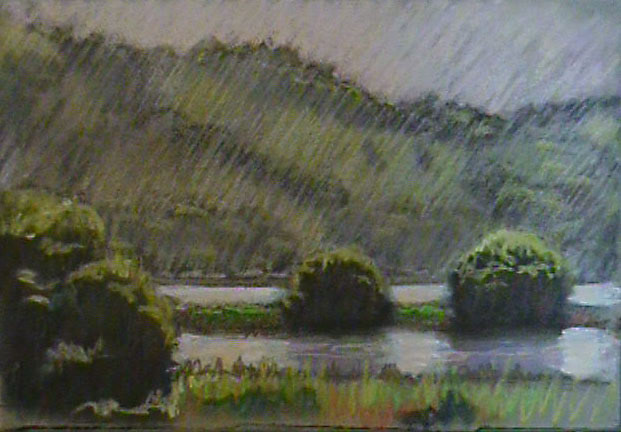
Austrian Rain

A poem by Leanna Praetzel, Fall 2011


Austrian rain

Came.
Simply not
The same.
Swift the song
All along
Red roof,
Window pane.

Your name,
Scattered

In the breeze.
Carried clouds
About,
Among the trees,
Mountain top,
Through my hair.

You were there.

Thunder,
Soft and sweet.
Different.
Sin
And mercy meet.
At my window,
In my room,
Incomplete.