Google Search

Google
 
Showing posts with label Salzburg. Show all posts

Friday, September 23, 2011

The Hills Are Alive…

A blog post by Leanna Praetzel, Fall 2011


The time I laughed the most during a movie?  Thursday, September 15th, 2011, 8:00pm.  The movie itself?  Sound of Music.  It seems silly for that movie to be a knee-slapper, but hey, when you’re in a roomful of Salzburg-bound buddies, the overall mood is anything but dim.
A gift from the beloved Easter Bunny years ago, the Sound of Music VHS at my house has been greatly cherished.  So, to have the fountains, statues, gardens, and more from the movie sitting before my very eyes was stupendous!  On Saturday we went on a tour through the quaint city, seeing many of these landmarks along with fun little shops and gorgeous churches.
During free time, I journeyed with my friends to a hilltop abbey where scenes from Sound of Music were filmed.  However, we didn’t appreciate the abbey simply for its fame.  We also were able to enjoy a spectacular view along with the beautiful voices of nuns singing in the choir loft of the chapel.  Leaving was an adventure in itself; I walked through a doorway expecting the abbey gift shop only to find myself in a cute little cloistered nun’s kitchen.  “Nein, nein!” she said with a smile as she affectionately shooed five ignorant Americans out her door.
In the evening some of us attended a concert in a building at “Mirabell Gardens” (think “Do Re Mi”!) where a group of musicians played masterpieces composed by none other than Wolfgang Amadeus Mozart, a Salzburg native.  Music-lovers of many backgrounds attended; we sat next to a lovely lady from Russia.  The diversity of the people there helped me to see music as an entire language of its own—I might not understand the words of the German sitting in front of me and vice versa, but we both can, without any difficulty, comprehend the extraordinary harmonies singing from a talented Austrian man’s violin.
Sunday morning found me posing next to the Sound of Music gazebo and eating a rose-flavored dessert (petal and all!) at an old café.  After leaving Salzburg, the buses hauled us all to a pretty little town called “Mondsee”.  There, I was fortunate enough to attend Mass at the Basilica in which the Sound of Music wedding took place, swim in the lake where some breath-taking scenery was shot, and pick “souvenir” grass to stash in my backpack for my silly friends back home.  (Love you guys!)
Overall the weekend was a hit.  So much so, that on our way to visit some castles in Germany next weekend, my friends and I are actually going to stop in Salzburg again!  (We hope to see a miraculous statue of the infant Jesus, and attend a “Mozart Mass”.)  But I shouldn’t get ahead of myself… before that, it’s Poland or bust!

Monday, February 14, 2011

A Busy Few Weeks: Salzburg, Munich, & the Kartause


A blog post by Brandon Otto, Spring 2011

Grüß Gott!

It’s been a busy couple of weeks in Austria. With classes, travelling, and hanging out at the Kartause, I’ve definitely had my plate full.

Last weekend was our excursion to Salzburg and Munich. To get geared up for that, two days before we left, there was a showing of The Sound of Music, and someone even brought a drink suited to the occasion: Edelweiss beer. The bus ride to Salzburg included a group rosary and most of the movie Sophie Scholl – Die Ietzten Tage (Sophie Scholl – The Final Days), a 2005 film about a famous member of the White Rose, an anti-Nazi non-violent student resistance movement in the 1940s. Sophie, her brother Hans, and their friend Christoph Probst, were executed February 22, 1943, for treason. They all attended the University of Munich, and there are now memorials in Munich dedicated to their courage in opposing the Nazis. Thus, it made a fine and thought-provoking introduction to Munich.

Friday in Salzburg was a fairly open day: there was Mass, lunch, a tour, and a concert. I spent most of the day wandering the streets of Salzburg with some friends, finding interesting locations and stores. One place we discovered was the Kollegienkirche, an absolutely beautiful church that, although in the middle of renovation, was stunning in its decoration. Unlike most baroque architecture we’ve seen, its decoration was based around white instead of gold, and it lent an air of breathtaking simplicity to the church. I’d highly recommend a visit there for anyone visiting Salzburg.

Salzburg is just a gorgeous city (one of the professors keeps saying it’s the most beautiful city in the world, although she might be somewhat biased: her father is from Salzburg), so just wandering around was a treat. Since the day before was Mozart’s birthday, my friends and I stopped in to see Mozart’s birthplace and home in his early life, which was filled with artifacts, even down to Mozart’s wallet and hair. After some more walking around town, and a stop at the Augustiner, a popular beer garden in Salzburg, we went to the Schloss Mirabel (Mirabel Palace) for a classical music concert, consisting of works by Mozart, Beethoven, and César Franck. They were all chamber pieces, with the only three instrumentalists being two violinists, one of whom also played the viola, and a pianist. My favorite piece was a collection of themes from Mozart’s operas Die Zauberflöte (The Magic Flute) and Don Giovanni arranged for two violins; it included one of the most well-known themes from these operas, “Der Hölle Rache kocht in meinem Herzen” from Die Zauberflöte, popularly known as the Queen of the Night aria. To the end the night, my friends and I shared a bottle of what we believed at first to be wine, but turned out to be champagne, filled with 23-karat gold flecks.

The next day was spent in Munich, which, again, involved spending most of the day wandering with my friends. We saw the Glockenspiel, an old clock with many moving figurines that dance at the hour. We also visited St. Michael’s Church and St. Peter’s, where you can find the body of St. Munditia, patron saint of single women looking for husbands. After climbing the tower of St. Peter’s to get a good view of Munich, my friends and I wandered to an open market to find lunch, which for me included weißwurst, a sausage that is a Bavarian specialty. Following lunch, we ventured to the Deutsches Museum, the world’s largest museum of science and technology.It covers 47 square kilometers, which is roughly 18 square miles. There are sections in the museum for almost any topic you can think of. One of my favorite parts of the museum was a simplified theremin, an early electronic musical instrument played by moving your hands in the air near the instrument’s antennas: there’s no need to even touch the instrument. Its eerie sound is often associated with old horror or science fiction films: for instance, it was used in the scores for The Day the Earth Stood Still and the classic Charleton Heston film The Ten Commandments (which is neither horror nor science fiction). The simplified theremin at the museum was actually allowed to be played which, I must say, I was very excited about. On the way back from the museum, my friends and I ate some fast food Turkish barbeque. Back in Salzburg, I went with a group of students to eat kebaps, a Turkish dish that is the basis for Greek gyros, and then visit an Irish pub.

The last day of the weekend, in Salzburg, began with Mass, but my friends and I decided to start the day slightly earlier. At a nearby church, there was an advertisement for a performance of Mozart’s vespers at 9 AM. To our surprise, the performance was not actually vespers: it was a Mass involving Mozart’s music! To make it to the Mass the rest of the group would be at, we had to leave early from the first Mass; to our even greater surprise, the other Mass also included Mozart’s music! Following Mass, we drove to Mondsee for lunch and a bit of sightseeing. The most well-known sight in Mondsee is the church where the wedding scene from The Sound of Music was filmed. After all of this, we safely returned to Gaming for a well-deserved rest…until class the next morning.


This past weekend, I stayed back in Gaming. At first I had trouble finding any events going on or any people to hang out with, but I learned that that’s just a symptom of the morning: after noon passes, people seem to be a lot more active. Friday night, I attended the Divine Liturgy with a group of hikers/skiers from Britain. The Divine Liturgy is, in a sense, the equivalent of the Mass in the Byzantine Rite. The Byzantine chapel on campus was created by students from the International Theological Institute, who used to stay at the Kartause until a few years ago. It’s an awe-inspiring chapel, featuring icons of saints from both the Western and Eastern Church. I hope to be able to find some more Eastern Catholic services before the semester is through.

Yesterday, Saturday, I joined a few other students for a hike up Book Mountain. The name is a bit of a misnomer: my household brother from Alaska claims that it’s not tall enough to match the technical definition of a mountain, and supposedly it’s not even the original Book Mountain. Its German name is completely different, but the students here refer to it as Book Mountain because, well, it’s a tall natural structure with a book at the top that a hiker signs to prove he’s survived the climb. Due to the warmer temperatures lately, the snow has mostly melted, making the trail a bit slippery with its mix of mud and slush, but it was still a pretty quick climb for me: it only took about 2½ hours to go to the top and back. Of course, I was going fairly fast, so others took longer, and my household brother made it in much less time (although he does everything quickly).

Now it’s Sunday, and I’m just resting, following a Mass concelebrated by a Slovakian priest who spent many years in Siberia, a British priest, a Chinese priest, and an American priest. It feels very international to hear them all reciting the Our Father in German. That’s been all the excitement I’ve been involved in lately: hopefully in another week or two I’ll have even more things to blog about. Until next time, God bless! Auf wiedersehen!

Thursday, February 10, 2011

Salzburg, Munich, & Dachau Inspire

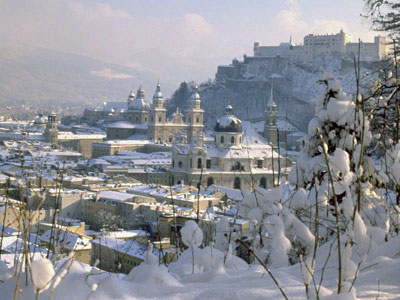
This weekend the majority of us here at the Kartause traveled to Salzburg and Munich, where we saw the famous hills so adoringly described in The Sound of Music. We also had a chance to experience the heart of German culture and Catholic tradition by traveling throughout Munich’s churches and landmarks. The first night in Salzburg was very peaceful. A group of my friends and I trekked up the hill where Salzburg Castle (or Festung Hohensalzburg) is situated. After much climbing through the outer boundaries of the castle, we encountered a breathtaking sunset on top of a cliff that gave us a vast view of Salzburg. It was such a blessing to be able to view a glimpse of the glory of God through the sky and the landscape.

After our first night in Salzburg, we woke up early to ride the bus to Munich, where we celebrated Mass in the same church that our German Shepherd, Pope Benedict XVI, used to celebrate Mass as Archbishop of Munich--Munich Frauenkirche (Cathedral of Our Dear Lady). After Mass, we were given a small tour of some of the famous Catholic sites in Munich; it was so fascinating to walk in the footsteps of our pope and to pray where he prayed. I don’t think it hit many of us that we were actually walking through the same streets where he would walk when he was living there. It was definitely a moving experience, to say the least.

Munich is only 10 kilometers (about 6 miles) away from one of the most famous (or infamous) sites in the history of World War II--Dachau concentration camp. I was able to travel there with some of my friends, and when we arrived, I couldn’t believe how tangibly I could feel the history of that place. First of all, the grounds were so immense and so empty that I could only imagine just how many people under persecution walked those same rocky roads I did, over 75 years earlier. As I put one foot in front of the other, I tried to place myself in the shoes of a prisoner in the camp during the time of the Holocaust. Of course, I couldn’t picture the immense darkness they must have faced. Yet, as we were walking in between the buildings, we saw the sunset shine through the gates--a sign of hope; a light in the darkness. The sunset made me think of the hope of Christ’s resurrection, through which he conquered all death and darkness.


I don’t have even a slight idea of what the Holocaust victims suffered. Just being where some of them were for so long and under such torment was enough to open my eyes to the little things I often take for granted--a comfortable bed, a hot meal, a family to come home to. I was also reminded that we have a duty as human beings to fight for those who cannot fight for themselves. We are called to respect each and every person--no matter how young or old; what race, age, or gender--out of the dignity given to them by the almighty, faithful, and loving God.

Moreover, to me, the sunset at Dachau was a reminder of the Resurrection of Christ. There was darkness, yes, but the hope that shone in the midst of it was more than enough to conquer this darkness.

These lessons are some of the most important things I learned this weekend in Salzburg and Munich. Needless to say, it far exceeded my expectations of what I thought I would be doing in Munich--that is, sightseeing, shopping and maybe some beer tasting. Rather than doing these things, God led me to a piece of history through which he inspired me to never take his blessings for granted. And for this, I am eternally grateful.

Tuesday, September 8, 2009

What I learned in Salzburg / Munich?


Yesterday, Fr. Ron Mohnickey, T.O.R., encouraged the students to not only travel to the glorious and historically abundant cities of Europe, but also to think and reflect on their experience upon their return.


He asked them, what did you learn?

Perhaps the answer would go something like this:

I learned that....
  1. Salzburg has a unique history being an independent principality of the Holy Roman Empire. This unique history includes being governed by a Prince-Archbishop, a singular combination of religious and political power. Sometimes the power was abused or the church laws spurned, as with Prince-Archbishop Wolf-Dietrich and his mistress which he had 15 children with. In following the history of the rise and fall of power, I have come to understand that humility is one of the greatest attributes which man can possess. Humility in the face of God, the church, and with one's fellow neighbor.

  2. Europeans have a tender devotion towards their dead, beautifying their tombs and often keeping them attached to their churches. It has caused me to reflect on my attitude towards the faithful departed.

  3. European cities are strewed with bells. This was often to remind them of their internal freedom and that the gift of life is truly a gift. Its to remind them that they are dust and unto dust they shall return. It causes me to reflect that as Americans we have an uncanny fear of death. It has caused me to savor life more and appreciate his graces in a new way. I'm more grateful now.

  4. The tradition of the beer hall in Europe is quintessentially human, inviting deep and real relationships to form and for life to be celebrated.

  5. In Munich, the statue of our Lady stands in the center square, reminding all who pass that her power is in her goodness and her greatness lies in service. It is Mary who really gives us a model for servant Leadership.

  6. In contemplating Pope Benedict's time in Munich, I realized in a deep way that life without beauty is no life at all and that for Benedict, truth is beauty and beauty is truth.

  7. I have begun to touch what a truly Catholic culture is: a kaleidoscope with God at the very heart and center. Other attributes include a deep appreciation for food and fellowship, a deep sense of one's history and customs, of habits of the heart (mores), an embracing of language, art, music, and dress, and a sense of one's roots, a way of life and of convictions that form one and teach one "how to be" in the world.

  8. Living through Nazism, Pope Benedict knows that evil exists; that it is banal, and that is always flourishes without God. This allowed him to realize that Love makes the world beautiful. This is a key to his priesthood.

  9. On the way home, we went swimming in the Mondsee, a crystal-clear alpine lake. We swam and played in the water with childlike hearts. I have come to learn that all of God's creation is good and brings us closer to him whether it be water, beer, churches, music, food, Mass, or even just talking and sharing. What matters is where our heart is centered and who is number one.